Thursday, 8 May 2014

A Spring Symphony of Birdsong, Flower and Awesome Promise

The Forest Garden is maturing fast after 12 years of establishment and is attracting more wildlife than ever, this includes several new species of birds including Goldcrests,Willow Warblers and Lesser Whitethroat. I have also spotted a male Coockoo Bee, its jet black and quite rare. They are here to enjoy the bounty provided by the ever increasing variety of flowering shrubs and trees and what a show of blossom we are enjoying right now as the pictures below show.
 
The mild weather over winter and spring has made all the difference and now that the chance of severe frost and hail has passed we can look forward to an abundant harvest. Right now we are picking bamboo shoots and of course rhubarb.
 
My Eco Corner
 
Just thought I would make a few Eco comments each post so here's the first.
 
I am a vegan and have been for 12 years now, before I was a veggie for many years. I converted to a veggie mainly due to the animal welfare issues and I must say the diet agreed with me so I didn't find it difficult to convert.
 
I converted to being a vegan in 2002 when I leaned about the dangers of dairy foods and eggs from various experts assembled at an Anthony Robbins Life Mastery Course and that all made sense to me to. So my diet became vegan as did my clothes and shoes, it was a real life style change and as before I really enjoyed the changes and challenges and still do.
 
Finally I was able to complete the puzzle when I realised that if we are to survive on this planet we have to eat less meat and consume less dairy. The space and cost of rearing meat and milk is far higher than equivalent in veg, fruit and nuts. In fact much land is given up just to feed ruminants, farmers keep their cows in so the grass can grow and supplement with unnatural feedstuff usually soy based (90% of the world soy bean crop is fed to animals). I say this is crazy as is the non organic chemicals used to grow the grass and cerials that get fed to cows etc in vast amount's which eventually finds its way into the groundwater and we all end up being exposed to this.
 
So being a vegan is to truly be part of a sustainable eco system and having just celebrated my 70th birthday and still can swish a scythe with the best of them and manage my 4 acres by hand. I truly believe that a vegan diet is the healthiest option for energy and happiness and  it may lead to a longer life too, now that would be a Brucey Bonus!!! Why not have a think about this and give it a try, you will be amazed at the difference it will make to you.
 
Back to the plants, here are just a few of the many in flower
 
 Cornelian Cherry flowering in Feb
 Almond with a special visitor in March
 Nanking Cherry in March
 Juneberry with the first wasp seen in March
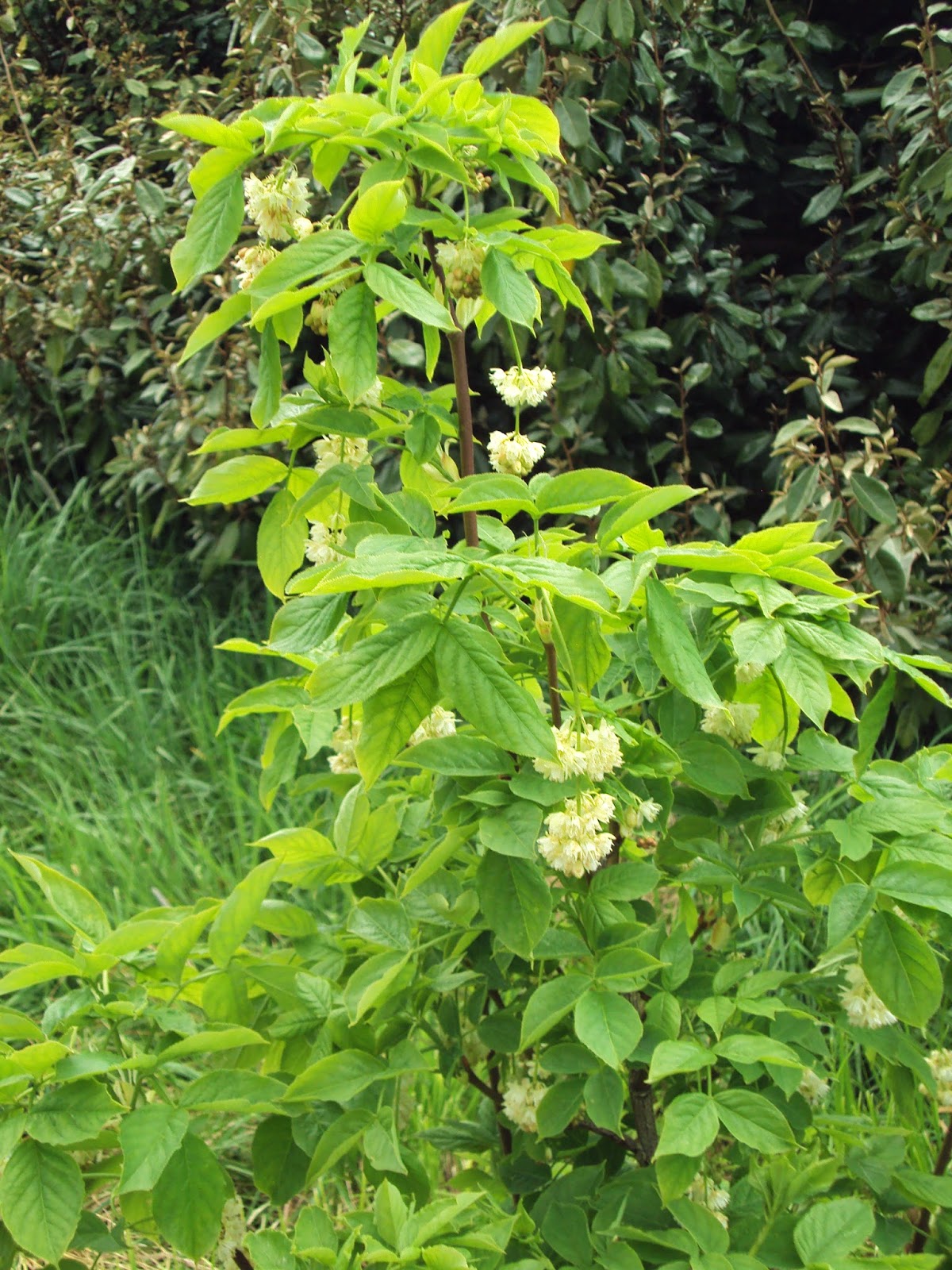
 Bladdernut in April
Finally a Morello Cherry in late April
 
For me its a really bust time as the grass is growing fast and needs constant scytheing the trees and shrubs need mulching there are early cuttings to be done, the polytunnel and greenhouse need attention to check seed sowing progress and plant up the tomatoes and I still have branch snedding to do from this winters coppicing, I only managed this blog because its raining today. So next time I hope to report on the first fruit crops so see you then.

Thursday, 20 March 2014

Global Warming , Agroforestry, some Coppicing and Blossom as well.

Recent floods after prolonged wet weather have been a salutary lesson for a lot of people and in some cases their business. What I have learned from the Forest Garden is this.

A higher density of trees in the landscape controls the flow rate of excess rain water off the land this combined with the rough pasture underneath the trees adds to the ability of the land to absorb much more water than otherwise. I was astounded to find that I could dig  planting holes for my 20 new trees without finding water and was able to actually crumble the soil in my hands.

Take a typical arable farm with massive field size and monoculture cropping the rainwater has nothing to stop it in the winter and as a result there is run off and or flooded fields. Or look at a dairy farm with cows constantly compressing the soil whilst grazing leaving the fields bare and hard for the winter. Where is all that rain going to go certainly not very deep into the soil.

My Forest Garden has taught me a lot over the years but this years lesson is the most important of all thus far. Trees are a vital part of the agricultural landscape and if we are to avert the vagaries of global warming within our farming communities we need to move away from monoculture and include trees as part of the farming design. It is called Agroforestry its been around for thousands of years and it works. For more information about this type of farming please go to www.agroforestry.co.uk

Lady day is nearly upon us and this marks the end of the coppicing season so since the rains stopped I have spent all my time managing the strips of land adjacent to the hedgerows. Several old willows have blown over and been held up by others so some very patient deconstruction has been taking place and of course the work has given me a fresh supply of firewood for 3 years hence.

Here are some seasonal photos taken over the last few days.


This golden willow is  just 12 years old and is already over 10 metres tall
                                                  A woodpile following coppicing

                                 Blossom at last... this is Nanking Cherry (Prunus tomentosa)


                                      Here we have a Japanese plum var methley (P.salicina)

                      This is Almond robijn (P.dulcis) a Dutch variety said to do better in the UK


Wednesday, 5 February 2014

Reasons to be Cheerful

The way we have suffered with the weather over the last weeks and still are right now, optimism about the oncoming spring is really hard to conjure up. We had a sunny interval yesterday so I decided to have a walk around my much neglected forest garden and was quickly reminded that the force of nature endures most things, including incessant rain and gale force winds and apart from a few broken branches there was no terminal damage.

Whilst passing the Eleagnus I noticed to my amazement that flowering had finished and fruits had formed, could this be due to the hot summer and the extremely mild winter thus far? Further up I came to my hazel orchard already resplendent in thousands of drooping catkins now joined by the tiny red star shaped petals of the female flowers, they all looked happy enough and hold out the promise of a bountiful harvest of nuts next autumn or maybe earlier as they seem so advanced. Then on my way back to the house I saw that the Strawberry Tree (Arbutos unedo) was still in flower having bravely survived all through the worst of the storms so far.
 
Finally another little gem my Cornelian cherry (Cornus mas) waiting to burst into flower. here's the picture gallery,
Hazel catkins showing a female flower (if you look closely)


Eleagnus fruits
 

Dainty bell shaped flowers of the Strawberry tree 

 
Flower buds just about to burst on the Cornelian cherry
 
During January I visited the fantastic gardens at  Schumacher College near Totnes in Devon and couldn't resist adding these pics, not bad for the 14th January. Oh yes another sunny interval!!


 This is part of an avenue of mature witchazel this not only looks spectacular but smells divine.

 
 Now this is what I call a strawberry tree with massive fruits which unfortunately were past their best for eatng.

So I am back indoors having dutifully filled the log cupboard hopefully for the last time tonight. That sunny interval but just a dream, I can at least reflect with some optimism that this will all be behind us  soon and that spring will have its way.

Wednesday, 18 December 2013

Phytopthera ramosa spreads to West Wales


The dreaded Phytopthera ramosa has struck Pembrokeshire's population of larch trees with vengeance,
so much so that it has arrived just 10 miles away from my forest garden. Now the larch is not a forest 
garden tree, though its timber is a valuable soft wood commonly used for construction, indeed my
compost loo frame is made from it. 
 
I inherited 3 Larch tees which are over 30 years old when I moved into the property 12 years ago and they have become a quite a prominent part of the garden architecture with their graceful swaying branches providing protection form the wind and shelter form the sun.
 
About 2 months ago I received an email from the Pembrokeshire Coast National Parks warning of the rapid spread of PR and that they have already had to clear fell a plantation of larch in the Gwuan valley as some of the trees had become infected. I wrote back asking advice on my 3 trees especially as these were located near to my sweet chestnut trees and I knew that PR can affect these also.
 
My answer came a few days later saying that it would be wise to fell them as it is inevitable that they would become infected and that this would mean that I would loose the Chestnuts as well. So in just one day my three 30 year old larches were felled and lo there was light and a lot of wood to process.
 
So I've lost the Larches but gained firewood and kindling and an awful lot of hard work. For the record Phytopthera ramosa was first found in imported larch saplings in 2010 it also affects bilberry, possibly all the vaccinium family and the rhododendron family.
 
It affects Larch more veraciously due to the massive colonisation of the needles from the PR spores some 50,000 can be found on a single needle. The spores can spread in the air or in water and already infected trees have been found in almost every part of mainland UK. Sadly there seems to be no let up in the spread and destruction of Larch and worse still the mild start to winter will insure an increased survival rate of the spores and an increase in infections next spring.
 
So far there is no news of possible methods to restrict the spread or discovery of any resistant clones.
 
Before felling with my Mulberry tree almost underneath.
Wain from Aberteifi Tree services expertly dismantles the first one
Some of the bounty from the felling, which includes 3 new chopping blocks. The stumps have been left 4 foot tall so that I can have them sculpted into appropriate images. Now I have to split the  rounds, saw up the side branches and collect and stack the kindling before I can reclaim the lawn.


Friday, 6 December 2013

Championing Sweet Chestnuts

Chestnuts waiting to fall.
Anyone with a sweet chestnut tree near to their home will know what a great year it has been for this superb nut. I am lucky enough to have not 1 but 2 of these majestic trees just a 30 meters from my door, well I did plant them on purpose of course because I just love to eat chestnuts and a forest garden should include them if its large enough. My trees were planted just 11 years ago and this year I have managed to collect about 12Kg of nice quality nuts.

I well remember as a child my Dad taking me into Richmond park to collect chestnuts from some truly magnificent trees may of which still stand today, in those days the public were still allowed to collect them but nowadays they have to be left to the deer and squirrels. I did manage to use my shoes to peel the prickly burr to reveal the nuts but it was quite tricky and was quite a knack. I also remember well trying to peel the inner skin (pedicule)off the raw nut so I could get a taste of the nut in its raw state but beware if this wasn't taken off entirely the nut was virtually inedible. When we got them home and roasted them all the undesirable bits came away easily and the delightful irresistible taste of roasted chestnut hooked me for life.

As a vegan chestnuts have become an important part of my dietary regime but I have to say getting them ready to eat is not without its challenges.


A|s the trees are accessed every day the nuts are best dealt with immediately as the pedicule is more easily removed whilst it is still in its damp fresh state. If allowed to dry then the process becomes more difficult. This year the sheer weight of the crop meant that I could not keep up, so into the fridge they went ( nb I must invest in a bigger fridge for next season).  After many different methods of processing I came up with what I consider the ultimate solution, unless anyone has a better method(suggestions welcome)

taken out of the husks using protective gloves.
Keep a saucepan half full of water on a rolling simmer. Take 6 nuts cut a cross in the  pointed end,pop into the water for about 2 minutes. Take out and replace the nuts with 6 others. The skin and pedicle will come away easily taking about 2 mins so you can keep a constant stream of production until your complete batch is finished.

Now with the partially cooked nuts you can put them in the fridge for a few days or freeze them for cooking later. Of course if you just want them for roasting keep them in their skins and when roasted both the skin an pedicle will come away fairly easily.

What to do with the semi cooked nuts then.


How about a chestnut roast, here is my first one ready to be wrapped in greaseproof paper and stored in the freezer.I have me 3 so far ready for the festive season.

Perhaps a chestnut and mushroom wellington, I am now working up some recipes and as soon as perfected will be happy to publish to my readers.

Chestnut flower is also another option as well as chestnut puree which can be converted into delicious sweet dishes. I will have ago at both after Christmas and report my findings.


I should also tell of the reason why this posting is rather late. Well its Phytopthera Ramosa the dreaded pathogen which has been devastating the larch population in West Wales .I had 3 healthy trees but was warned that they would eventually succumb and as this pathogen also attacks sweet chestnuts I was advised to act sooner rather than later. So my 3 -35 year old trees had to be felled. There was and still is a lot of work left for me to do as the tree surgeon only took a day to complete the work, I  wanted to use every part of the wood branches and needles so after cutting the trunks into rounds I have all the rest to do. I do have the benefit of more light , 3 nice chopping blocks and a years supply of firewood. I have lost the graceful pendulous swinging arms of those beautiful trees which graced the garden for such a long time. We can only hope that some way will be found to re introduce this important tree some time in the future.


Friday, 18 October 2013

A Cracking Harvest and Some Georgous Sunsets

Forget the fact that it was a bad year for the Prunus Family this year the apples have out performed all expectations, my George Cave eventually produced 62kg and other varieties are easily beating last years totals.


One plum that did well for me was this Mannacan which has a delightful apricot flavour
Apple Lady Sudely best for juice or eat within  a week as they go wooly after this time.

 
As at today I am still picking the following apples, lanes Prince Albert a great keeping cooker some 25kg off a small tree,Golden pippin and Pitmaston pineapple both small but prolific and good keepers. Still to come are the lates of Adams pearmain and Cornish gillipepper (so named after carnations).

Sweet chestnuts have just started falling and look likely to produce a heavy crop.
Waiting on the tree to be picked I have 3 hawthorns and 2 Medlars and Devon sorb apple (Cornus devoniosis).

One of the things that Forest Gardens planted with so many different cateories of food is the sheer variety available and with this comes a array of nutrition that does not appear in the modern diet. Eventually a well planned Forest Garden could have over 200 different fruits, berries, herbs, nuts,leaves ,flowers and various medicinal and chemical uses, besides providing fuelwood, stakes, bean and pea sticks, cordage and weaving material.

Could this type of organic farming be a model for the future efficient production of food, that will enable a growing population to survive? Already my diet has changed dramatically with over 50 different foods in quantity this year alone, with more being added all the time.

Medlar Big Russian ripening, they will be picked as late as possible and then left to ripen in a light cool area. To me they taste rather like dates and are highly nutritious

ripening every day like magic my Black Mulbery Illinoi to me these fruits taste like melon, the tree produces thoousands of them enough for the birds and me.


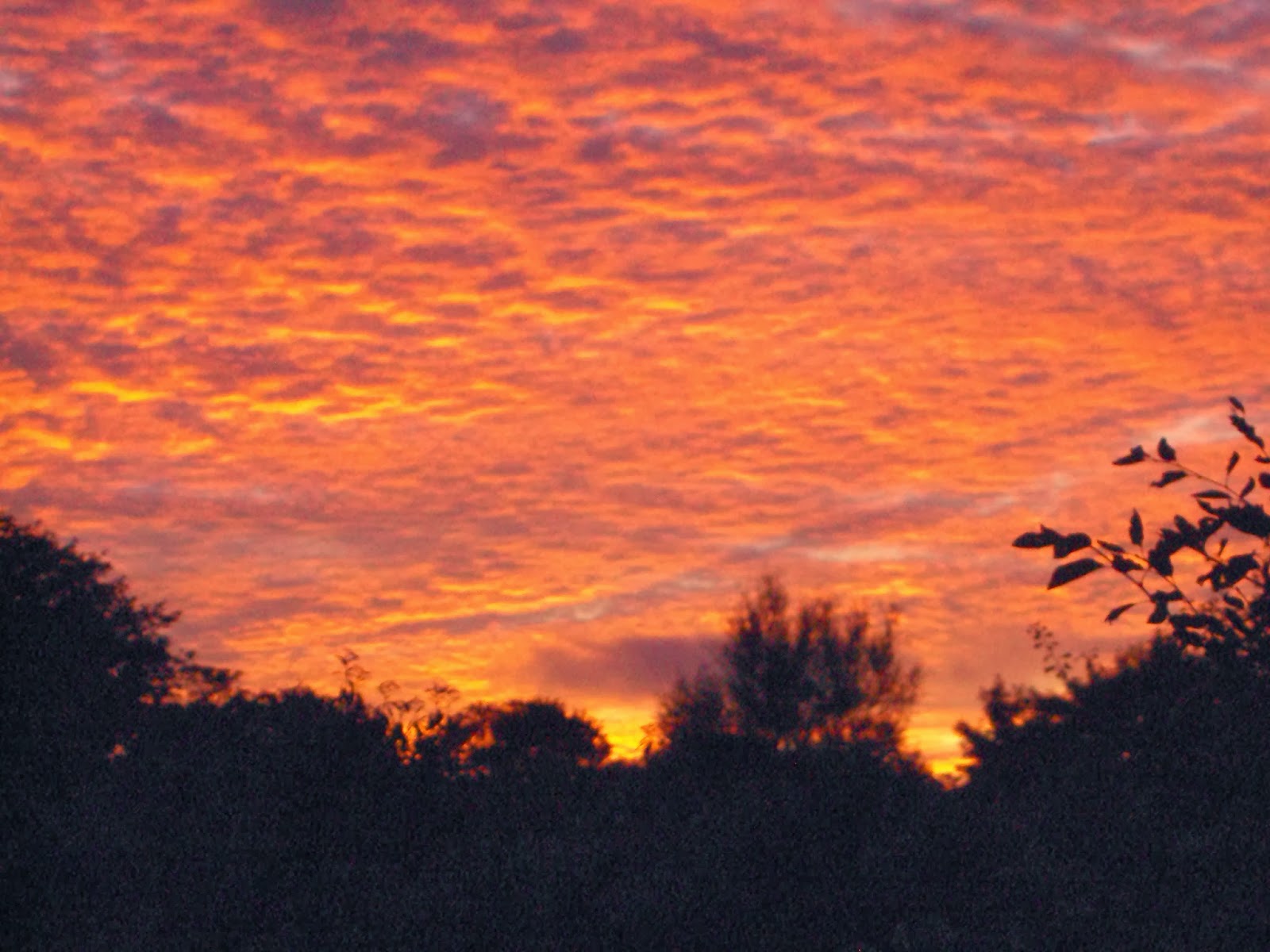
I am so lucky to be living here in West Wales when the conditions are right we get some fantastic sunsets especially in September so I thought I would share this with you.
Next time I have to share a really sad story with you as the March of Phytopthora gains a serious foothold in Pembrokeshire. Till then.

Wednesday, 4 September 2013

An Abundance of fruit and a Wryneck to boot

When planting up unusual shrubs one always thinks of the time when you will be privileged to actually try the fruit. This summer was the year that I was able to pick my first crop of Salal berries. The shrub is known as Gaultheria shallon and is a great addition to a forest garden as it is a productive shade lover. Although it will produce about 500g of fruit this year it spreads readily by suckers and if allowed will cover around  1 meter square each year. The berries are slightly smaller than blue berries and have a sweet wine flavour the seeds are tiny so easy to eat without pips everywhere. Evidently they taste even better when dried as the flavour intensifies. What's more you can make a herbal tea from the dried powdered leaves.

Gautheria shallon showing leaf and a profusion of berries
This plant has an intriguing history,evidentally it was a favourite berry of several North American native tribes. They would typically visit the Salal fields when the berries were ready and press them into cakes or loaves and dry them in the sun for consuming in the hard winter months. They also used the leaves as medicine for stomach disorders and they would chew the green leaves and spit out the residue onto an open wound to help the healing process. The berries are loaded with vitamins and antioxidant's so can be made an important part of the diet as they prevent degeneration. They deserve to be grown more widely, they certainly grow really well here in West Wales and I will be using many more as ground cover as part of my shrub layer.

Other berries that are looking good are Blueberries however the bushes need to covered with nets to stop the birds taking them. My best bush so far has given me 1.2kg of tasty berries.2 more shrubs are about to crop Cornus mas (cornelian cherry) and Aronia (purple and black chokeberries) More about them next time.

Apples look really good this year and foremost among my trees is the early  George Cave, this is such an underrated tree but believe me for a healthy tasty crop that usually starts in early July this apple has no match. My tree is just 11 years old and this year I will have picked over 50Kg of fruit that's a wow in my book. So I'm juicing for the freezer eating as many as seems appropriate, giving some to grateful neighbour's and selling the surplus at my gate.

just a small section of this fantastic George cave apple tree
Pinus pinaster or the Maritime pine has been growing as part of a windbreak for 8 years now. Last year I spotted the first cones and this year they have progressed.
This shows a 2 year old cone with a new one formed this year underneath, next year should see my first pine nuts!

 
Here is a strange shrub Staphlea pinnata (bladdernut) its exiting for me because in its 2nd year it has produced a single bladder and there should be a seed/nut case inside. It will be ripe by the end of Sept so I look forward to opening it and checking out the seed.
Staphlea pinnata with bladder.
Lastly but most exiting is the appearance in the Forest garden of a very rare bird, certainly you would not expect to see one so far West. Its the Wryneck which I found foraging for ants right in front of my house. Evidently a number have been spotted on the east coast as they come over from Scandinavia and Russia during the summer months, such a pretty bird a little smaller than a greater spotted woodpecker, with a black streak on each side of its head. My sighting was Tuesday 3rd September. Still looking to see if its stayed over but no sign yet!
the Wryneck
Till next time then.